Open verification infrastructure for high-risk artificial intelligence
Volume I·
Number 1·
Filed 25 May 2026·Lisbon
A Statement of the Problem
The EU AI Act compels every high-risk system to keep a complete log of its decisions. It does not compel that the log be trustworthy — and today, no off-the-shelf technology makes it so.
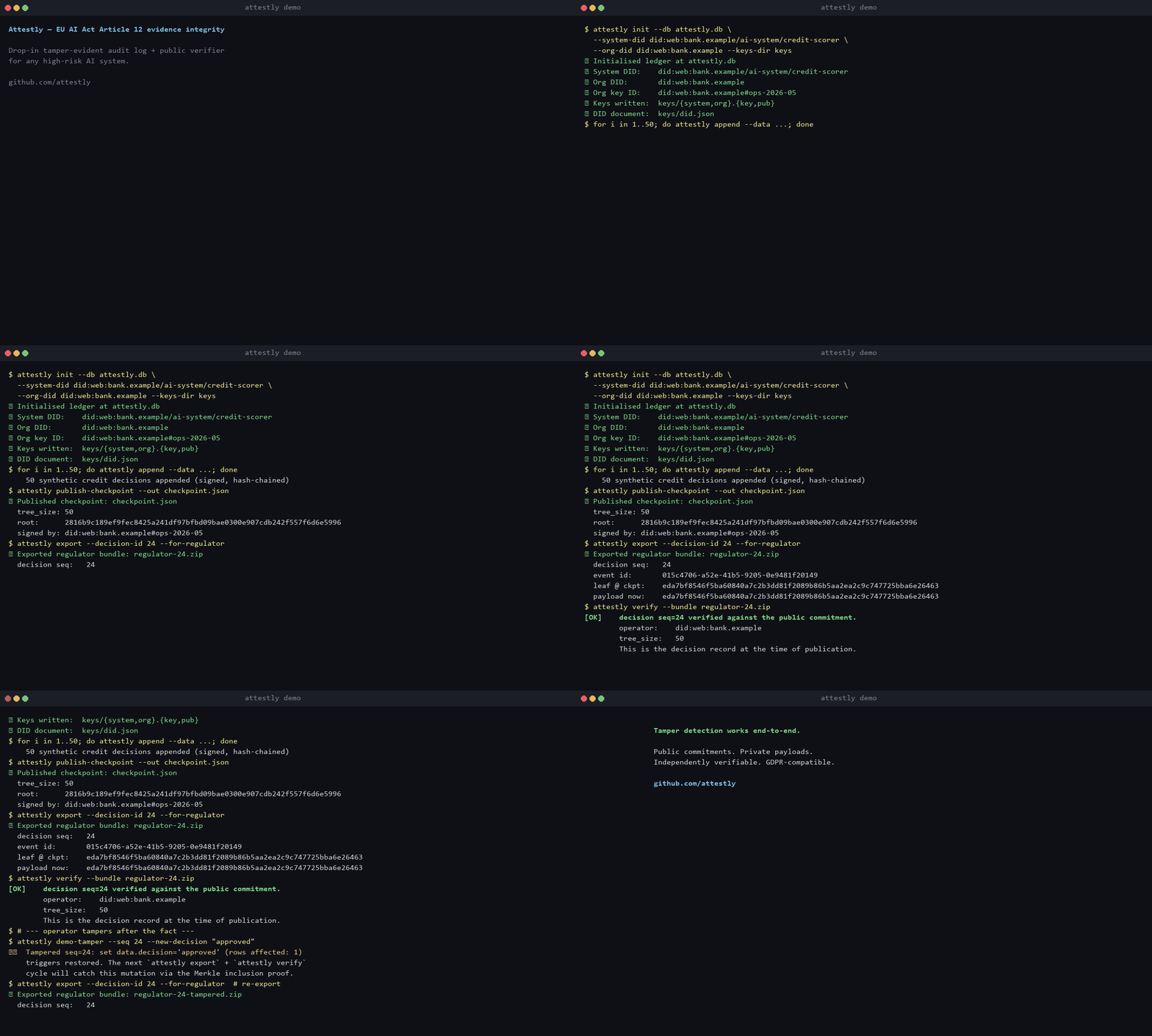
Plate I.End-to-end cryptographic tamper detection. A regulator's evidence bundle verifies on legitimate data; the same bundle fails — with the precise hash mismatch reported — when the operator alters the database after the fact.
§ 1 · The Statute
Article 12 mandates the log. It does not mandate trust in the log.
From 2 August 2026, every high-risk AI system placed on the EU market — credit scoring, hiring, biometric identification, employment, essential services, law enforcement, migration, justice1 — must maintain automatic logs over its lifecycle.
The legal text says the logs must exist. It is silent on whether the logs can be trusted. Today a company can edit its own audit trail before a regulator inspects it, and there is no technical means by which the regulator can detect the edit. Penalties for record-keeping failures reach €15 million or 3% of global turnover.
Attestly is the integrity layer the regulation forgot to specify — published as open digital base infrastructure, not as a vendor product.
§ 2 · The Library
Three primitives. One drop-in.
ArticleILedger
Append-only signed events
Every AI decision is canonicalised, hashed, signed with the system's Ed25519 key, and appended to a hash-chained ledger. Database triggers enforce append-only at the SQL layer; cryptographic chaining enforces it at the storage layer.
Merkle roots are periodically published to a transparency log as signed commitments — never the underlying decisions. The Signed Tree Head is the only data that touches public infrastructure. The decisions remain private to the operator.
RFC 9162 · Sigstore Rekor compatible · GDPR-safe by construction
ArticleIIIVerifier
Regulator-runnable, no operator trust
A standalone CLI and a browser-WASM verifier. A regulator drops an exported evidence bundle into the tool and receives a mathematical verdict — independent of the operator's claims, independent of any vendor.
Rust 1.85 or newer. SQLite bundled. No other runtime dependencies. The end-to-end demo runs cleanly on Linux, macOS, and Windows.
# Clone the sourcegit clone https://github.com/attestly/attestlycd attestlycargo build --release# Run the end-to-end verification demobash examples/demo.sh# Windows equivalentpwsh examples\demo.ps1
Surface
State
Notes
attestly-core · Rust library
v0.1.0 · active
65 tests passing (workspace). CI: Linux · macOS · Windows.
attestly-verify · CLI verifier
v0.1.0 · active
Single static binary; reproducible build.
attestly-tella · Tella adapter
v0.1 · active
Append-only attestation for Tella uploads; media stays private to the operator.
attestly-tella-sidecar · HTTP service
v0.1 · active
Zero-dependency HTTP wrapper for Uwazi / ODK / Nextcloud deployments.
WASM browser verifier
in development
Drag-bundle-and-verify UX for regulators.
Production transparency log (Tessera)
scheduled
Pending grant outcomes.
Independent security audit
scheduled
EU-based firm; commissioned upon grant award.
§ 4 · Cross-References
Grounding.
Attestly is designed against the EU regulatory text and the international evidentiary standards a court will reference. The architecture is conventional and prior-art-supported: Merkle's 1979 binary authentication tree4, Haber & Stornetta's 1991 cryptographic time-stamping5, the Certificate Transparency model from 20136, and the Sigstore Rekor model from 20217.
Attestly's contribution is the binding to Article 12 evidentiary requirements — not novel cryptography. That is the right choice for regulator confidence: a court should not be asked to assess a new primitive.
§ 5 · Applicability
Beyond Article 12.
The primary surface is EU AI Act Article 12 — that is what the regulatory deadline forces and what the funding pipeline targets. But the underlying primitive is general. The same append-only ledger, the same Signed Tree Heads, the same regulator-runnable verifier serve any domain where a single party both produces and stores evidence about its own conduct.
Two adjacencies are already in scope:
Civil-society and journalism field evidence — captured material that must remain court-admissible against later authenticity disputes. The integration adapter and HTTP sidecar are shipped for Tella (Apache-2.0); partnership conversation in progress with the International Bar Association's eyeWitness to Atrocities programme.
Cross-sector regulated trust — every domain producing structured evidence under emerging EU regulation (eIDAS 2 Qualified Electronic Ledgers; the Digital Services Act; CSRD audit obligations; supply-chain due-diligence regulation) faces the same integrity gap and can adopt the same primitive.
Attestly stays narrow on what it ships: an open library, a verifier, a specification. The breadth lives in how many other workflows can pick it up — not in a platform Attestly itself becomes.